
 Skincare · Beirut · English


Point Planist at a store. It reads the brand, plans the month, writes the copy, makes the designs and sends your client a WhatsApp link to approve. Six agents do the work. You decide what ships. Built for agencies, brands and online stores.
14 days free. Nothing charged until day 14.
Pick a plan, add a card, and your 14 days include the brand scan, the brand brain and up to 20 finished posts. Cancel before day 14 and you pay nothing.
VELA and Nuqta are brands we made up so we could show the product without borrowing a real client's logo. Every screen, design and script on this page came out of Planist. The count below is VELA's run, start to finish.
This is VELA going through Planist, one stage at a time. Pick a stage, or let it run.
Reading the palette and the type


Weekly meeting · VELA · six agents reporting
The week in what we madeAgent spend for all of it: about $20.
How the month dividesFour pillars, written at onboarding, before a single post.
A caption from this weekStep three is the one people skip.
Not intentionally. It just gets moved, applied too early or saved for mornings when there is more time.
Facebook Feed 1:1 · The Six-Step Ritual
This week's visuals, and their scores
The pass mark is 7. Anything under it went back and was made again.
October, slot by slot27 slots, 4 a week, across Instagram, TikTok and Facebook.
Where the client got toOpened on WhatsApp. No account, no PDF, no login.
Reporting · Performance AnalystHere is the week. I am not going to tell you how it performed, because no channel is connected yet. I can tell you what we made, what passed, and what it cost.
Ideation · Creative StrategistThe month splits four ways. The barrier takes the largest share because it is the thing this brand is actually about.
Copywriting · CopywriterEvery caption is held against seven tone words before you see it. Precise and calm, transparent, unhurried.
Design · DesignerFour this week. Each carries the score the brand check gave it, and anything under the pass mark was made again.
Content planning · Content PlannerOctober is planned end to end. Four posts a week across three channels, and every slot carries its reasoning.
Account management · Account CoordinatorThe client has been through October on the review link. Three approved, ten notes left, and one of them is already a rule.
 Reporting
 Ideation
 Copywriting
 Design
 Content planning
 Account management
Planist detects the platform, reads the palette and type from the stylesheet, finds the logo and primes the catalogue with photos and prices.
Five colours, the type, a creative direction and a tone of voice, saved before you have finished the form. Every design starts here and the brand check reads from it.
Twenty-seven slots for October, four a week, each with the reasoning behind it. One button sends the whole month to the client.
Built from VELA's own packshots, not a stock bottle. Every visual runs the brand check before you see it, and the library holds the ones that passed.
A private review link per month. The client sees each post with the thinking behind it and taps approve or asks for a change. Every note goes back into the brand brain. An approved post then publishes itself on the date the calendar gave it.
The six agents that ran the brand take the board in turn: what they made, what it scored, what the client said. Approve a step in the room and it is queued as work rather than written down as an intention. See the room.
Planist reads what a brand already has, a store's catalogue or a website's photographs, and builds the month from it. Nine industries below, each with what went in and what came out. The bottle in the design is the bottle in the store.

This is the whole input. Planist read the store once and took the six product photos, the three brand photographs and every price exactly as listed. Nothing was uploaded, retouched or written by hand.
These nine are the industries with a demonstration brand built for them. Professional services has a playbook of its own, and any other industry starts from the general playbook with the brand's own strategy on top.


VELA. A store. The designer is handed the product photograph itself, so it is the same bottle in every format.


Sindiane. A fourteen-room hotel. Real photography of the property only, rates with dates or no rates, as the hotel playbook requires.


MARAM. A modest womenswear label. Its photographs go to the designer as reference; fabric and light are kept through every format.


Zaytoun Bistro. A Levantine bistro with its own olive grove. Food shot in natural light, never a stock image, and a price only when it is a real offer.


ARKAN. A residential developer. Finished interiors and a real site as reference, and a playbook that never invents a price or a date.


AXIS Physio. A sports physiotherapy clinic. Plain language, one idea per post, and never a promised outcome, because the clinic playbook forbids them.


The Plato Forum. A mentorship studio for students. Parents' questions answered directly, one clear next step, and children shown only with consent.


Bidaya. A coding school for refugee teenagers. Dignity first, one ask per post, numbers only when verified, as the cause playbook demands.


Tila. A savings app for the Gulf. The product working rather than an illustration of it, one feature per post, in the customer's words.
Nine industries, nine brands, and the same rule in each: the brand's own pictures go in. For a store that means the product photograph itself, so it is the same bottle in every crop. For a hotel, a label, a developer, a clinic or an app it means their photographs go to the designer as reference, so the designs look like the brand's own pictures rather than a different world. All nine brands are fictional, built so the product could be shown end to end.
Each of these industries has a playbook of its own: Retail, Hospitality, Fashion, F&B, Real estate, Healthcare, Education, NGO, Technology. The general playbook covers the rest.
 Product shot
 Carousel slide
 Post
Post Carousel slideBannerPortrait
 Carousel slideStory
 Carousel slide
 BannerPost
 Carousel slide
 Offer
Offer Carousel slidePostPost
 Product shot
 Carousel slide
 Product shot
 Product shot
A school, a bistro, a hotel and a clinic, each seven slides. They turn on their own; swipe or use the arrows to go at your own pace. Every slide passed the brand check before it got here.


A skincare label in Beirut and a payments app in Amman, made in the same week by the same six agents. Each was read from its own website. Nothing about the two looks alike.
Skincare · Beirut · English
 Payments · Amman · Arabic and English

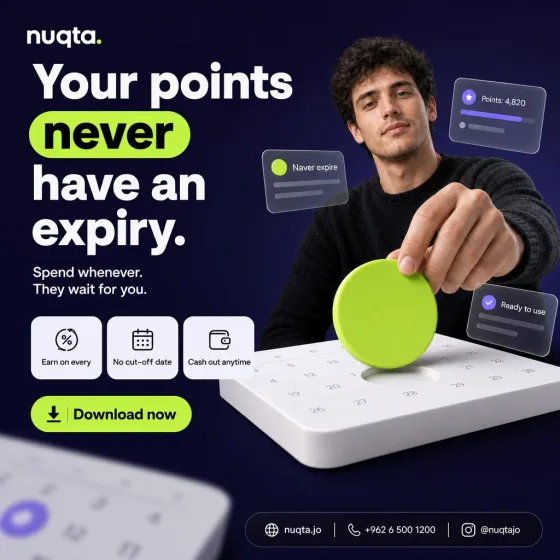


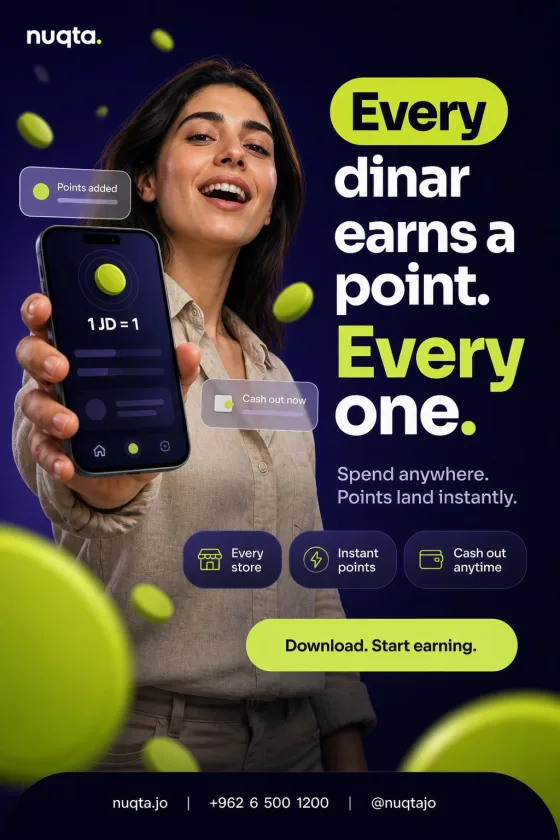
VELA and Nuqta are both made up, for the same reason: a real company's logo in here would claim a client we do not have. The work is not made up. Both brands went through the same brand check, and what failed it was left out.
Your store or website goes in the same way.
Start free trial 14 days free, cancel any time. See what the plans hold.Planist turns a post's own words into a motion video for Reels, Stories and TikTok. Your colours, your type, your real logo and product, and the exact price from your catalogue. It draws a storyboard, checks it and fixes it before anything is rendered.
A motion video uses 3 creations. Nobody has to film anything.
Every frame above is Planist output for fictional demonstration brands, not customers. The words on screen are checked against the approved copy before a video is made, so a motion video never says something the post did not.
Most tools start from zero every month. This one remembers. When VELA's client asked for the serum to sit higher in the frame, that became a rule for every design after it.
Can the serum sit a little higher in the frame? Otherwise yes.Design rule · from feedback on "Why Your Skin Feels Different in October"
The bigger the point, the more often that rule was asked for. Drag the brain to turn it. See what it keeps and why.
Concepts tied to what the brand is selling this month.
A month of slots with the reasoning behind each one.
Captions and scripts in the brand's voice, English or Arabic.
Visuals from the real packshot and logo, in every format.
Status, the review link and the note that goes with the work.
What went out and what it cost, per brand and per run.
Four pillars, a share of the month each, and the post that came out of one slot in every one of them.
For skincare-literate adults who have outgrown the noise, VELA is the Beirut-made label that treats the skin barrier as the whole conversation — six essentials, made in small batches, priced honestly, and built to last.
Written at onboarding, before a single post.
Your skin barrier isn't a concept. It's a structure.
A layered matrix of lipids, ceramides, and proteins sitting between you and everything autumn throws at it — dry air, temperature swings, the first week of heating season.
When that structure is intact, moisture stays in. Irritants stay out. Your skin does what it's designed to do without asking for much.
When it's compromised, you feel it. Tightness. Sensitivity that wasn't there in July. Products that used to work, not quite working.
Autumn is the most predictable stress test your barrier faces all year. Not because the season is harsh — because the shift is rapid. Your skin adjusts. The question is whether you're giving it what it needs to do that well.
Ceramides reinforce the lipid layer. Niacinamide at 5% reduces transepidermal water loss. A stable vitamin C formulation keeps the barrier bright while it repairs.
These aren't trends. They're mechanisms.
Step three is the one people skip.
Not intentionally. It just gets moved — applied too early, layered over the wrong thing, or saved for mornings when there's more time.
Here's why it matters where it sits.
The Vitamin C Glow Serum — 15% L-ascorbic acid, fragrance-free — belongs after your toner and before your moisturiser. That sequence isn't arbitrary. A prepped, hydrated barrier absorbs the active more evenly. Occlusion after locks it in. Apply it to dry, unprepped skin and you're working against the formulation.
Step one cleans. Step two hydrates. Step three brightens and reinforces the barrier. Steps four through six seal the work.
Miss step three and the rest of the routine is doing less than it should.
The Vitamin C Glow Serum. $48. Link in bio.
📌 Pin this post. Full sequence in comments.

Plain talk about the serum we're most asked about.
15% L-ascorbic acid. Ferulic acid. pH 3.5. Here's what that combination actually does — and what it doesn't.
Full ingredient list. Link in bio.

Vitamin C oxidises.
Not eventually. Progressively — from the moment it's formulated.
At 15% stabilised L-ascorbic acid, the margin for degradation is narrow. So we keep batches small. Not as a story to tell. Because the concentration on the label needs to match what's in the jar when it reaches you.
That's the whole reason.
Formulation notes → link in bio.
One private link per review. The client opens it on their phone, approves what they like and leaves a note on the rest. No account, no PDF, no forty-message thread.
October's content is ready. Eight posts. Approve what you like, leave a note on anything else.
app.planist.ai/review/vela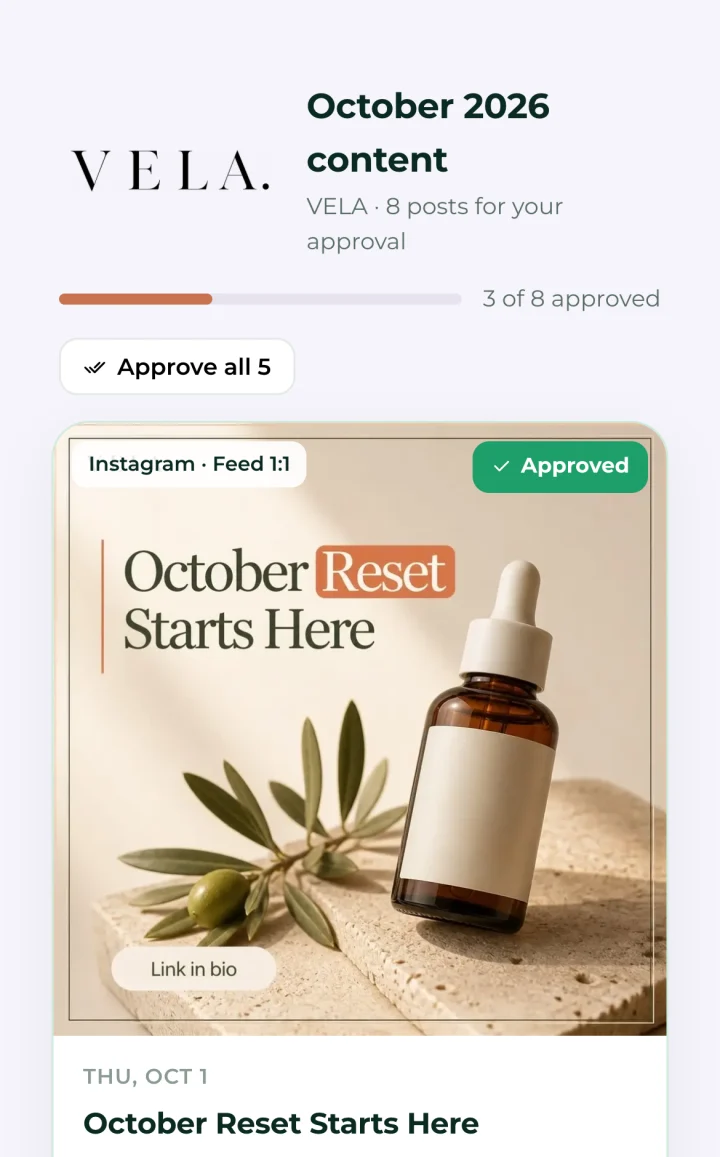
Send your first review link from your own workspace.
Start free trial 14 days free, cancel any time. See what the plans hold.Connect the brand's accounts once. Everything the client approves goes out on the date the calendar gave it, in the format each platform wants, without anyone opening an app to upload it.
Included on every plan, at no extra cost and no separate tier.
What each account can actually do depends on the platform and the permissions it grants. Planist shows you the real capability per connected account rather than a promise.
You say what you run on the first screen. A store on its own gets Products pinned under Dashboard and no client switcher. An agency gets Clients, Playbooks and Team. Same agents, different room.

One brand, one workspace. Products under Dashboard, no client list, no team tab.

Thirteen on the books. Each with its own pieces, agents and spend. Clients, Playbooks and Team in the sidebar.
Each with its own brand brain, calendar, library and approval link.
No client list, no team tab, nothing borrowed from agency software.
Shopify, WooCommerce, Salla, Zid, Magento or BigCommerce. Products, prices, photos and palette come with it.
More than one brand, without the parts of an agency tool that need a team behind you.
A workspace, straight away. Point it at a website or a store and it reads the brand, writes the brand brain and makes your first posts before you have paid anything.
No. Not to create an account, and not to see what Planist makes for your brand.
Shopify, WooCommerce, Salla, Zid, Magento and BigCommerce. Any other brand goes in from its website. For store owners, there is a guide to marketing a Salla or Zid store.
No. For a store, the designer is handed the real product photograph. For any other brand, its own photographs go in as reference. Every design passes a brand check before you see it.
No. They open one private link on their phone, see each post with the reasoning behind it, and approve or leave a note. How to get posts approved on WhatsApp.
Yes. Connect the brand's accounts once and an approved post goes out on the date the calendar gave it. Planist does the brand strategy, the calendar, the copy, the designs, the client approval and the review notes, and publishing is included on every plan.
Yes, motion videos. Planist turns a post's own words into a short video for Reels, Stories and TikTok, with your logo, colours and product, and a reel in the calendar can arrive as a finished video. Each one uses 3 creations. There are four above.
Yes, and not only the captions. Nuqta's posters are set in Arabic and English together, typeset properly rather than dropped into a layout built for English. Both brands are side by side above.
It is priced per brand workspace, not per seat, and publishing is included on every plan. Every price and limit is on the pricing page.
The scan, the brand brain and your first posts cost nothing. Pick a plan once you have seen the month it makes.
14 days free. Nothing charged until day 14.